
The True Cost of Getting Payroll Wrong in Portugal
Late payments, wrong tax codes, missing social security contributions — payroll errors in Portugal carry real financial and legal consequences.
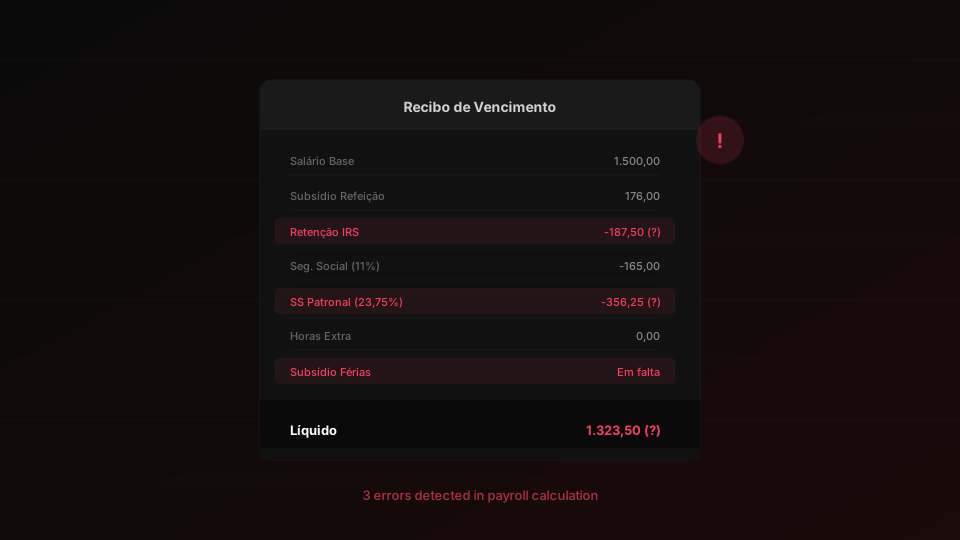
Payroll feels like it should be simple. You calculate salaries, deduct taxes, pay your people. How hard can it be?
In Portugal, the answer is: harder than you think. The country's labor laws are detailed, its social security system has specific rules for different contract types, and the tax authority (Autoridade Tributária) doesn't have much patience for mistakes.
Here's what can go wrong — and what it actually costs.
Late salary payments
Under Portuguese labor law (Código do Trabalho), employers must pay salaries by a fixed date each month. Late payment isn't just an inconvenience — it's a legal violation. Employees can claim compensation, and repeat offenses can lead to labor inspections by the ACT (Autoridade para as Condições do Trabalho).
Beyond the legal risk, late payments destroy trust. Your best employees are the first to leave when they can't rely on getting paid on time.
Incorrect IRS withholding
Portugal uses a progressive withholding system for IRS (income tax). The withholding rate depends on the employee's marital status, number of dependents, income bracket, and whether they're a sole or dual-income household. Get the rate wrong, and your employees either overpay (making you unpopular) or underpay (creating a surprise tax bill at year-end).
The withholding tables are updated annually by the government — sometimes with mid-year revisions. If you're not tracking these changes, you're almost certainly applying outdated rates.
Social security miscalculations
Employer contributions to Segurança Social are 23.75% of gross salary. Employee contributions are 11%. These rates are non-negotiable, and the penalties for underpayment or late payment are steep: fines ranging from several hundred to thousands of euros, depending on the severity and repetition.
What makes this tricky is that not all compensation elements are subject to social security. Meal allowances (up to the legal limit), for example, are exempt. But if you structure compensation incorrectly or exceed the exempt threshold without adjusting, you're either overpaying contributions or — worse — underpaying them and accumulating liability.
Holiday pay and Christmas bonus errors
In Portugal, employees are entitled to a "subsídio de férias" (holiday pay) and a "subsídio de Natal" (Christmas bonus), each equivalent to one month's base salary. These can be paid in full (June and November/December, respectively) or spread across 12 months — but the rules around pro-rating for new hires, part-time workers, and mid-year departures are surprisingly complex.
Miscalculating these subsidies is one of the most common payroll errors. And because they represent significant amounts, the financial impact of getting them wrong is substantial — both for the employer and the employee.
Overtime and extra hours
Portuguese labor law has specific rules for overtime compensation: 25% extra for the first hour, 37.5% for subsequent hours on workdays, and 50% for weekends and holidays. There's also an annual cap on overtime hours.
If you're not tracking overtime correctly — or not applying the right multipliers — you're either shortchanging employees (legal risk) or overpaying (financial waste). Neither is good.
The compounding effect
The real cost of payroll errors isn't any single mistake — it's the compound effect. One wrong withholding rate affects twelve months of paychecks. One miscalculated social security contribution creates twelve months of liability. One incorrect holiday pay calculation affects every employee.
And corrections are expensive. Amended filings, catch-up payments, interest charges, and the administrative time to untangle everything add up fast.
The alternative: get it right from the start
Payroll in Portugal is complex, but it's not unpredictable. The rules are clear, the deadlines are known, and the calculations, while intricate, are deterministic. What it requires is expertise, attention to detail, and systems that catch errors before they compound.
If you're running payroll manually or relying on generic software without local expertise, you're taking on risk that a dedicated payroll team could eliminate. The cost of professional payroll processing is almost always less than the cost of fixing mistakes — and infinitely less stressful.
Your employees depend on you to get this right. Make sure you can.
Onboardio Team
Finance Ops
The Onboardio team helps businesses across Portugal modernize their financial operations with subscription-based accounting, payroll, and compliance services.
Related articles
5 Signs Your Business Has Outgrown DIY Accounting
Spreadsheets worked when you started. But growth changes everything. Here are the signals that it's time to hand your finances to professionals.
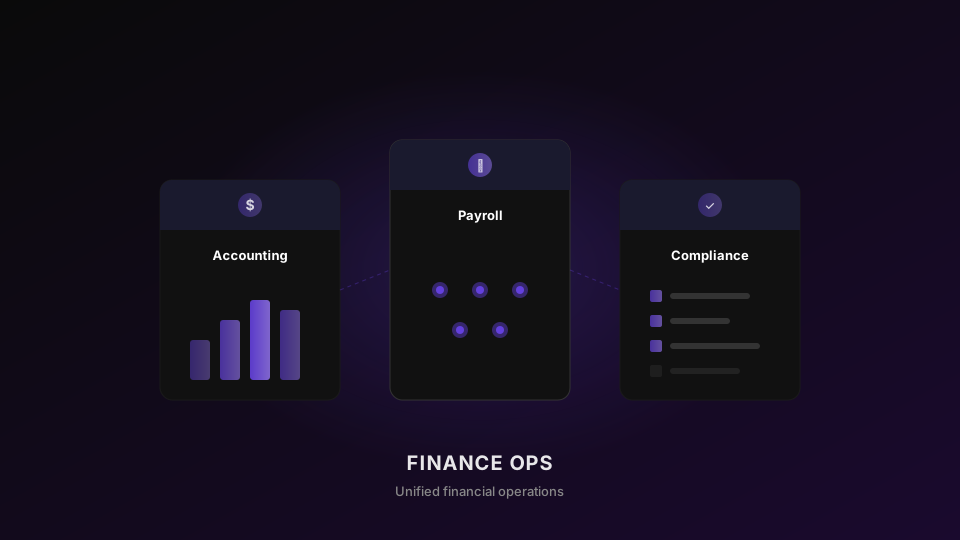
What is Finance Ops? The Modern Approach to Business Finances
Finance Ops is redefining how growing companies handle accounting, payroll, and compliance. Here's what it means and why it matters.